
TESDA AI-Assisted Mobile App Development Course in La Union
In This Article
- From Java to AI: Armada Logics Launches TESDA AI-Assisted Mobile App Development Course in La Union
- Mobile App Development Has Changed. So Has What Employers Expect.
- Where Mobile App Development and AI-Assisted Coding Meet
- Inside the Workflow of an Armada Mobile App Developer
- Built Inside a Working Software Development Company
- The Engineer Behind the Curriculum
- Who This TESDA Mobile App Development Course Is For
- What This Means for La Union and Region I
From Java to AI: Armada Logics Launches TESDA AI-Assisted Mobile App Development Course in La Union
LA UNION, Philippines | October, 2026
Armada Logics is now registered to offer TESDA AI-Assisted Mobile Application Development Level III, the first provider in Region I to do so. The company received its Certificate of TVET Program Registration from TESDA Regional Office I on July 6, 2026. The registration authorizes Armada Logics to deliver the qualification to learners in La Union and across Region I under national competency standards.
When Armada Logics opened its first Programming (Java) NC III batch in 2025, the goal was simple: give Filipinos with little or no coding background a real shot at a software development career. Two cohorts later, the company is taking the next step.
The course sits where two skill sets now meet: building mobile applications, and building with AI. Armada Logics doesn't teach them as two subjects bolted together. It teaches mobile app development the way its own engineers already work, with AI tools in the workflow from the first line of code.
What You Need to Know
- Course: AI-Assisted Mobile Application Development Level III
- Provider: Armada Logics, a TESDA-accredited training center based in San Fernando, La Union
- Delivery: Blended learning: scheduled online classes and face-to-face sessions, plus hands-on projects
- Duration: 30 days
- Start date, schedule, tuition, and registration: To be announced. Follow Armada Logics on Facebook and LinkedIn for updates
- Scholarships: TESDA scholarships available for qualified applicants
- Website: tesda.armadalogics.com
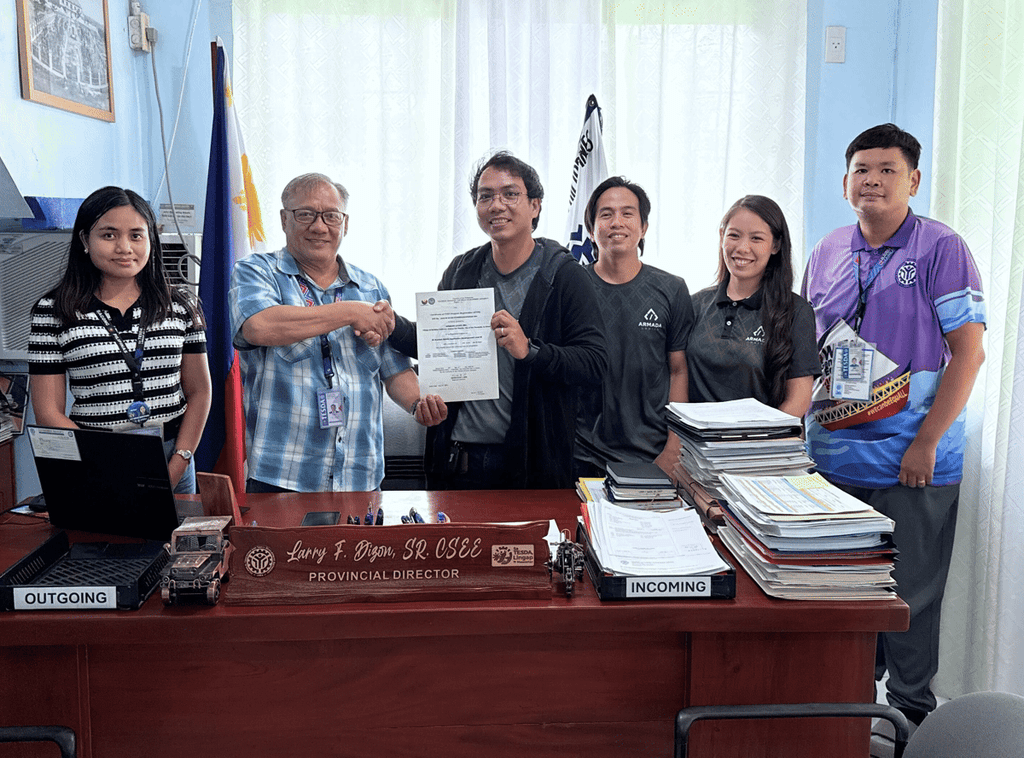
Receiving the CTPR from TESDA La Union Provincial Director Larry F. Dizon Sr., CSEE.
Mobile App Development Has Changed. So Has What Employers Expect.
Apps like GCash and Maya, plus e-commerce, delivery, and telehealth apps, have turned the smartphone into the main computer most Filipinos use every day. Every one of those apps started the same way: with a mobile app developer writing code.
What changed more recently is how those apps get built. Development teams now use AI tools to analyze errors, explain unfamiliar code, and move faster through routine work. Employers still need developers who understand programming logic, architecture, databases, security, and testing. But they now screen for one more skill: whether a developer can use AI productively and catch what it gets wrong.
The outdated approach: A developer who writes everything from scratch is slower than the market expects.
The risky approach: A developer who accepts AI output without checking it is a security risk.
The hireable developer: The engineer in between, who supervises AI while holding strong software fundamentals.
Most training programs still treat AI as a bonus skill. Meanwhile, the Philippine IT-BPM industry is expected to reach close to $42 billion in export revenue and nearly two million jobs by the end of 2026, with much of that growth coming from higher-value, AI-assisted work. This is the gap the TESDA AI-Assisted Mobile App Development course is built to close.
Where Mobile App Development and AI-Assisted Coding Meet
Plenty of articles say AI is now part of software engineering. Few explain where it earns its place in mobile app work, and where it can cause real damage in apps shipped to thousands of devices.
Where AI Delivers High Value
Cross-platform development: Learners build apps for both Android and iOS from one codebase. When platform-specific behavior in Android or iOS gets in the way, AI tools explain it in seconds instead of hours of documentation searches.
Boilerplate automation: Layout files, view models, navigation, and lifecycle handlers follow well-known patterns. That makes routine structure the safest, highest-value place to use AI.
Device fragmentation: AI tools can quickly build test plans across screen sizes, OS versions, and hardware that a tired developer might overlook.
Permission discipline: Google Play and the App Store reject apps that ask for access they can't justify. AI helps draft permission requests and fallbacks so apps pass review.
Where Human Judgment Must Lead
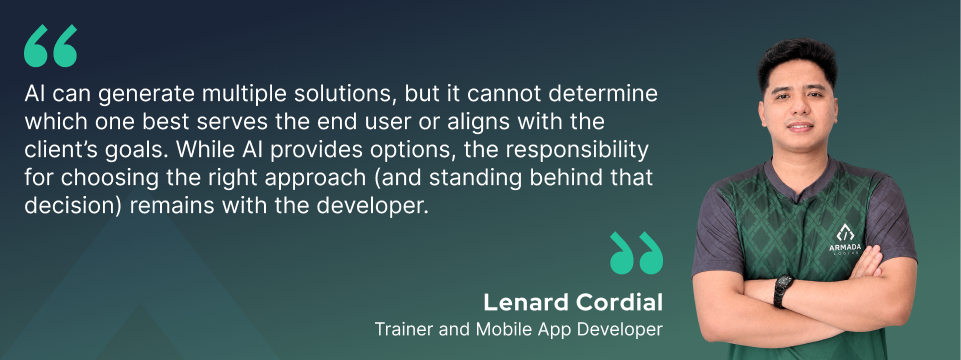
Security: AI can suggest security code that looks right but is wrong or outdated. The program teaches learners to check every AI output before keeping it.
Business logic and data conflicts: AI can list conflict-resolution methods, but it can't decide which record should win or how fresh data must be. Showing a stale balance in a banking app is a business failure, not a syntax error.
Inside the Workflow of an Armada Mobile App Developer
At Armada Logics, mobile app developers use AI to work through technical documentation, find out why an app crashed, and build test plans across devices. Renz Lester Halagao, a mobile app developer at the company, describes it as a productivity tool, not a replacement for engineering work.
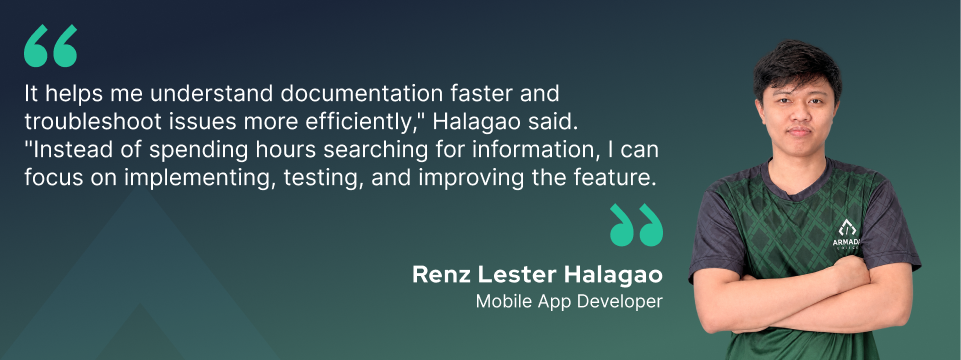
The most important decisions stay with people. Developers decide how an app should behave, weigh technical trade-offs, and make sure each solution meets client requirements, performance targets, and long-term maintainability. Every feature is reviewed, tested, and validated before deployment, and if something breaks after launch, the developers investigate and ship the fix, not the AI.
Built Inside a Working Software Development Company
Armada Logics is a software development company in the Philippines and a TESDA-accredited training center. Its engineering roots go back to 2011, when members of the team joined Village88, a startup incubation studio in San Jose, California. In 2012, they helped develop the technology behind Coding Dojo, one of the longest-running coding bootcamps in the United States. Armada Logics was founded in 2024 to continue that work from the Philippines and train the next generation of Filipino software engineers.
AI-assisted coding wasn't adopted for the classroom. It started in the company's own engineering work on live client projects, then moved into training, first in the Programming (Java) NC III program and now as a full TESDA qualification. Methods were proven on client work before they were taught.
The results show in the earlier batches. Three top-performing Programming (Java) NC III graduates moved into internships and then full-time roles, and between them they have worked across QA, backend, frontend, AI, and mobile app development. All three still work at Armada Logics today.
The Engineer Behind the Curriculum
Lenard Cordial leads training for the new program. He is a Curriculum Developer and Trainer at Armada Logics and also works as a Frontend/Mobile App Developer. Lenard is a Certified National TVET Trainer, holds a TESDA Web Development NC III, and is part of the team that built and delivered the Programming (Java) NC III program.
Because he builds frontend and mobile apps for a living, his lessons are built around building and debugging real things, not just slides. For a course where AI tools change month to month, that mix of hands-on engineering and teaching experience matters as much as the syllabus.
Who This TESDA Mobile App Development Course Is For
Based on who signed up for Armada's earlier programs, this course isn't only for IT and CS graduates. It suits learners anywhere in Region I who want to add mobile app development and AI-assisted skills to basic programming knowledge:
CS/IT students and graduates: College students or fresh graduates in IT, CS, Computer Engineering, or related fields.
Self-taught programmers: Developers who can build projects but lack a nationally recognized credential.
Working developers: IT professionals moving into mobile app engineering and AI workflows.
Senior high school ICT graduates: ICT or programming strand graduates with basic coding skills.
Career shifters and remote workers: Career shifters, OFWs, and returning overseas workers looking for tech skills.
Because the course doesn't require an IT/CS diploma, it opens the door to people who could do the work but never had a path to try.
What You'll Learn
Project planning: Defining requirements and scope for mobile apps.
App development: Building cross-platform mobile apps using current industry standards.
Responsible AI use: Applying AI tools at each stage of development.
Quality assurance: Testing, debugging, and improving code quality.
Mobile security: Secure login, encrypted storage, and safe permission handling.
Documentation and capstone: Writing professional documentation and delivering a production-ready mobile app.
What This Means for La Union and Region I
Students in Region I seeking specialized software training used to move to Metro Manila and pay rent before earning their first paycheck. Now, a La Union-based, TESDA-registered provider offers this qualification through a hybrid model, combining scheduled online and face-to-face classes. This setup allows Region I learners across Pangasinan, Ilocos Sur, Ilocos Norte, and La Union to get trained without moving away, preparing graduates to build apps for local businesses, Manila startups, or international teams.
That matters now. According to the IT and Business Process Association of the Philippines (IBPAP), industry growth is increasingly measured by the value each worker creates, not headcount, as the sector shifts toward AI-enabled services like software development and AI integration. A local pool of AI-literate developers gives La Union a stronger pitch for the outsourced software work driving IT-BPM growth nationwide.
For employers, this is a TESDA-recognized credential in AI-assisted mobile app development that didn't formally exist before. It says more than "I can code." It says a graduate can build with the same AI-assisted tools the industry already uses.
Frequently Asked Questions
Is the TESDA AI-Assisted Mobile App Development course free? It can be. Qualified applicants may get a TESDA scholarship (TTSP, TWSP, PESFA, STEP, or UAQTEA), depending on the slots allocated to Armada Logics for each batch.
Can I take the course online? Partly. The course uses a hybrid setup of scheduled online classes and face-to-face sessions, so applicants across Region I can join without relocating.
How long is the course? The course runs for 30 days. The next batch's start date will be announced soon.
Do I need programming experience? It helps, but it isn't required. Armada Logics provides free Web Fundamentals training before every cohort, so motivated beginners can catch up before the course starts.
What are the requirements? A photocopy of your birth certificate, a valid ID, a high school diploma or Form 137, and passport-size and 1x1 photos. You'll also need a computer, webcam, headset, and internet of at least 3 to 5 Mbps.
What will I be able to do after the course? You'll be able to plan, build, test, and secure a cross-platform mobile app using AI tools responsibly, and you'll finish with a production-ready capstone app.
What Happens Next
If it follows Armada's track record, the program will run the familiar way: hands-on projects and mentorship from engineers who use these tools every day. What's new is the subject. It's not just how to code, but how to code in an industry that no longer separates "developer" from "developer working alongside AI."
Registration details for the first AI-Assisted Mobile Application Development Level III batch will be announced soon. Follow Armada Logics on Facebook and LinkedIn to be the first to know, and for updates on upcoming free and paid TESDA training programs.